
Introduction
There's nothing more Kiwi than firing up the BBQ as the evenings lengthen across Paraparaumu, Waikanae, Otaki and Levin - but a gas bottle that's sat untouched since last summer deserves a proper check before it's back in daily use. Most gas safety incidents around the home involve LPG appliances that simply weren't checked before the season's first big cook-up, not faulty equipment. This guide covers what to check on your BBQ and outdoor gas setup before summer entertaining kicks off, when a proper outdoor kitchen installation needs a licensed gasfitter, and how much gas you can legally store at home in the first place.
Key Takeaways
- Every time you change a gas cylinder, a quick soapy-water leak test on the connection is essential - especially the first use of the season
- You can store up to 100kg of LPG at home (for example, two 45kg cylinders and one 9kg bottle) without needing special compliance checks or certification
- Position your BBQ at least a metre away from anything else, including walls, fences and other structures
- Gas cylinders must be certified by an authorised testing facility at least once every ten years, with the test date shown on the valve collar
- Outdoor kitchens, built-in BBQ units and any gas plumbed to a fixed appliance require a licensed gasfitter - swapping a portable BBQ bottle doesn't
- Rotten-egg smell, hissing sounds, or frost/ice on fittings are all signs of a potential leak and mean stopping use immediately
- Never store LPG cylinders indoors where it can be avoided, and never near drains, pits, or ignition sources
- All fixed gas installations need a compliance certificate from the gasfitter who completed the work
How Much Gas Can You Actually Store at Home?
New Zealand rules set clear limits on how much LPG you can store at a residential property before extra compliance requirements kick in. You can store up to 100kg of LPG - for example, two 45kg cylinders plus a 9kg bottle - without needing a specific site inspection or certification. Between 100kg and 300kg, your gas supplier is required to fix a valid compliance plaque in a prominent position near the cylinders as proof the installation's been checked. For most households running a BBQ and perhaps a patio heater, you'll sit comfortably under the 100kg threshold - but it's worth knowing where the line sits if you're planning a bigger outdoor entertaining setup.
Pre-Summer BBQ Safety Checklist
Before the first big cook-up of the season, run through this quick checklist.
Test the Connection for Leaks
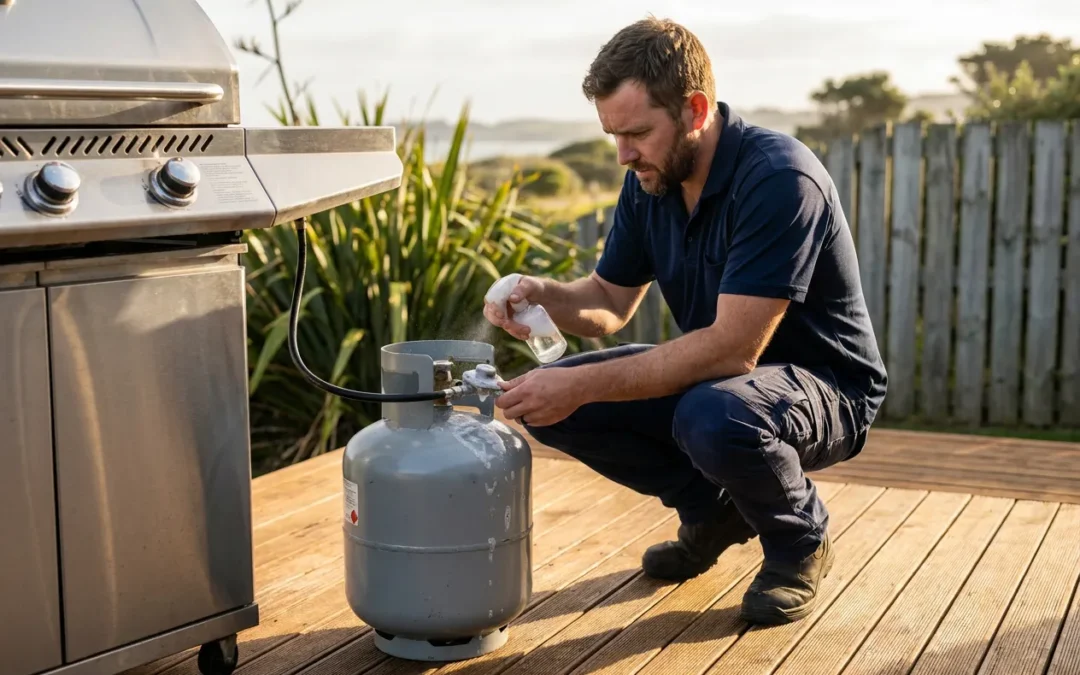
Every time you connect a new or long-unused gas cylinder, carry out a leak test: apply soapy water to the connection, turn the cylinder valve on, and watch for bubbles. If bubbles appear, turn the cylinder off, disconnect, clean the connection, check for damage, and repeat the test before use.
Check Hoses & Regulators
Inspect the hose running from the cylinder to the BBQ for cracking, splitting or perishing - rubber hoses left outside through a Kapiti Coast winter can degrade faster than you'd expect from salt air and UV exposure. If in doubt, replace the hose before the season starts rather than mid-BBQ.
Positioning Matters More Than You'd Think
Position your BBQ at least a metre away from walls, fences, plants and other objects, and never use it in an enclosed space like a garage or under a low overhang without adequate ventilation. Keep the gas cylinder itself upright, in a well-ventilated spot, away from drains and any ignition sources.
Outdoor Kitchens & Built-In Gas Features - When You Need a Gasfitter
There's an important line here that's easy to miss: swapping or connecting a standard portable gas bottle to a freestanding BBQ is generally something a homeowner can do themselves, following the checks above. The moment you move to a built-in outdoor kitchen, a BBQ plumbed permanently into a fixed gas line, or a larger bottled gas installation, you're into restricted gasfitting work that must be carried out by a licensed gasfitter - and every fixed installation needs a compliance certificate confirming it's been done correctly. If you're planning an outdoor entertaining area with a built-in BBQ or pizza oven this summer, get a licensed gasfitter involved at the planning stage, not after the benchtop's already been built around it.
Recognising a Gas Leak
Know the signs, and act on them immediately if you notice any:
- Smell - LPG has a distinctive rotten-egg odour added specifically so leaks are noticeable. If you smell it, don't use light switches, phones, or anything that could spark - turn off the gas at the cylinder if it's safe to do so, and get the area ventilated
- Sound - a hissing noise near a cylinder, hose or connection can indicate escaping gas
- Sight - ice or frosting on pipes, fittings or the cylinder itself, or a hazy shimmer in the air, can be a sign of a leak
If a leak persists after you've turned off the cylinder valve, don't attempt to fix it yourself - get it checked by a licensed gasfitter or your gas supplier before using it again.
Gas Bottle Swap vs New Installation - What You Can and Can't DIY
To keep it simple:
- Swapping a 9kg BBQ bottle for a full one, and connecting it to a portable BBQ, is generally something you can do yourself, provided you carry out the leak test above
- Connecting or disconnecting larger 45kg cylinders requires specific training, and it's strongly recommended you leave this to your gas supply company
- Any new gas fitting work - running a new gas line, plumbing a BBQ into a fixed supply, installing an outdoor kitchen - is restricted work requiring a licensed gasfitter, full stop
Patio Heaters, Cabinet Heaters & Other Portable Gas Appliances
BBQs get most of the attention heading into summer, but the same basic safety checks apply to any portable gas appliance with an attached bottle - patio heaters brought out for cooler evenings, cabinet heaters, or portable cookers used for outdoor entertaining. The Plumbers, Gasfitters and Drainlayers Board treats these consistently: connecting the gas bottle yourself is generally permitted, but the Board still strongly recommends using a gasfitter, particularly for anything that hasn't been used for a while or that you're setting up for the first time. If an appliance has sat in the shed all winter, treat it the same way as a BBQ that's been idle - full visual inspection, leak test on reconnection, and a check that the hose hasn't perished, before it's back in regular use.
Insurance & Gas Safety
It's worth knowing that home insurance claims involving gas incidents can be affected by how the installation was carried out and maintained. Fixed gas installations without a valid compliance certificate, or LPG storage that clearly breaches the residential quantity limits, can complicate a claim if something does go wrong. Keeping your compliance certificate for any fixed gas work, and simply following the basic storage and handling rules for portable cylinders, protects you on two fronts at once - safety, and your ability to claim cleanly if the worst happens.
Why Choose Duke's Plumbing
Duke's Plumbing has been delivering certified gas fitting services across the Kapiti Coast and Horowhenua since 2016. Whether you're planning a built-in outdoor kitchen for summer entertaining, need a gas line run to a new BBQ area, or just want peace of mind before the season's first big gathering, our licensed gasfitters can handle it properly - with the compliance certificate to match.
Planning an Outdoor Kitchen or BBQ Gas Line This Summer?
Get it done properly, by a licensed gasfitter, before the entertaining season kicks off. Get in touch with Duke's Plumbing today.
📞 022 543 8789 📧 admin@dukesplumbingltd.co.nz 🌐 dukesplumbingltd.co.nz
Duke's Plumbing - Quality Plumbing, Friendly Service.
Frequently Asked Questions
Do I need a gasfitter just to swap my BBQ gas bottle? No - connecting a standard portable gas cylinder to a BBQ is something you can generally do yourself, as long as you carry out a proper leak test on the connection each time.
How often do gas cylinders need to be tested? LPG cylinders must be certified by an authorised New Zealand testing facility at least once every ten years, with the test date displayed on the valve collar. Your gas supplier will also run a safety check when swapping cylinders.
Can I store my spare gas bottle inside the garage? Indoor storage should generally be avoided wherever possible. If you must store small quantities indoors, strict limits and ventilation requirements apply - outdoors, upright, in a well-ventilated spot away from ignition sources and drains, is the simplest and safest option.
What's the first thing I should do if I smell gas? Don't use any switches, phones or other potential ignition sources. If it's safe to do so, turn off the gas at the cylinder and open up the area for ventilation. If the smell persists, get it checked by a licensed gasfitter before using the appliance again.
Does a built-in outdoor BBQ need the same certificate as an indoor gas hob? Yes - any fixed gas installation, indoor or outdoor, requires a compliance certificate from the licensed gasfitter who completed the work.
Does using an unlicensed installer for a fixed gas line affect my insurance? It can. Restricted gasfitting work carried out by someone who isn't licensed may not be covered by your insurance if something goes wrong, and it won't come with a valid compliance certificate. It's a genuine risk worth avoiding for the sake of using a licensed gasfitter from the start.
Sources
- Environmental Protection Authority (EPA) - LPG at Home: https://www.epa.govt.nz/everyday-environment/using-lpg-gas-at-home/
- Plumbers, Gasfitters and Drainlayers Board - Advice for Consumers: https://uat-2023-pgdb.azurewebsites.net/advice_for_consumers/
- Rock Gas Hawke's Bay - Staying Safe: https://www.rockgashb.co.nz/staying-safe.html
- Tower Insurance NZ - LPG Cylinder Safety Tips: https://www.tower.co.nz/discover/house/lpg-cylinder-safety/
Duke's Plumbing Ltd offers premium plumbing, gas fitting, and drainlaying services across the Kapiti Coast and Horowhenua region, specialising in Infinity gas hot water systems, drain laying, certified gas fitting, full plumbing services, roofing and spouting, emergency plumbing repairs, and commercial and residential projects. Established in 2016 under the leadership of Luke (Dusty), our licensed team delivers quality workmanship with our motto: "Quality Plumbing, Friendly Service."